 SOFT
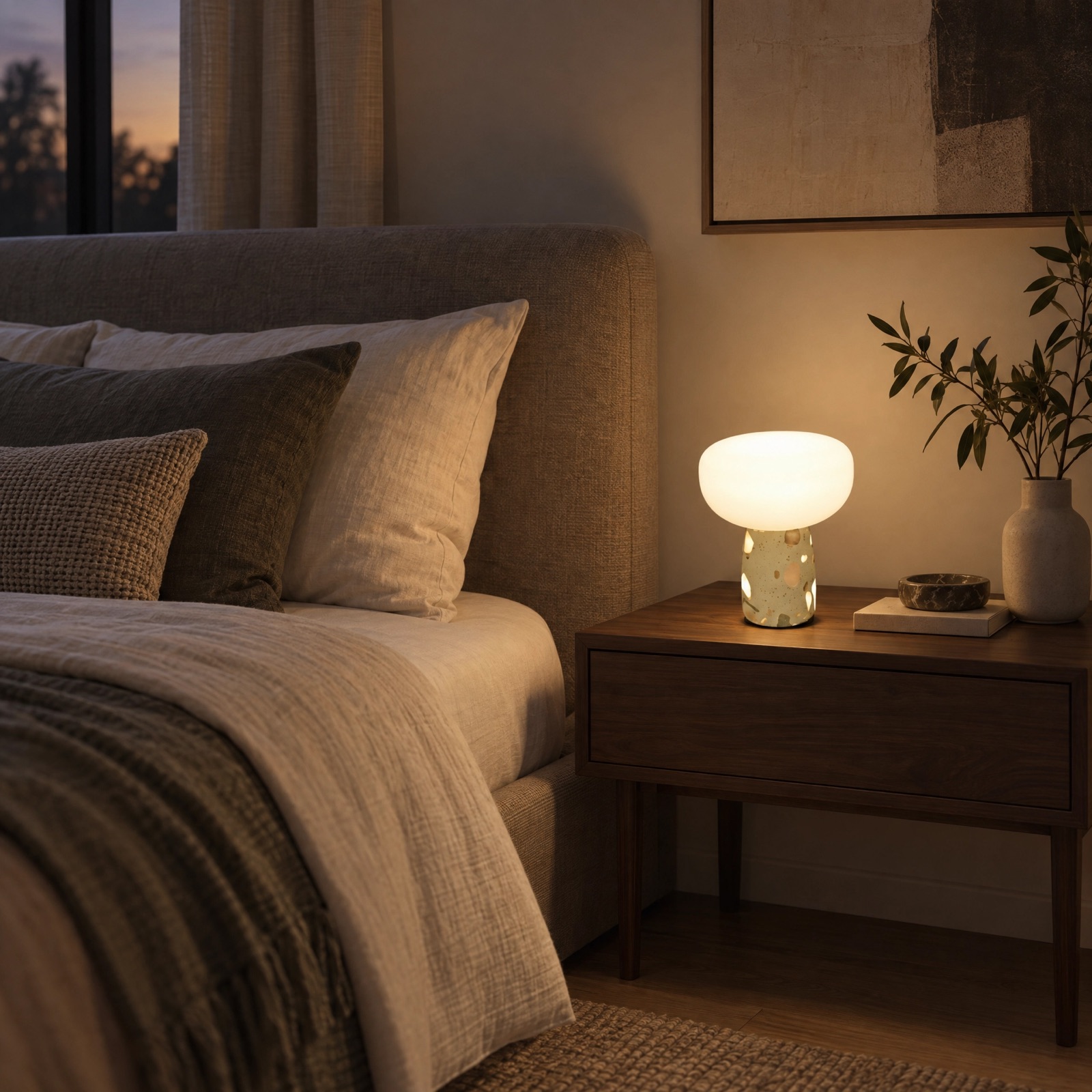
Dimming is where bedside lamps are won or lost in daily use: it is the difference between a lamp that lets someone read, then wind down, and a lamp that is either too bright to relax under or too dim to read by. This guide covers the control options that actually exist — touch, stepped, tunable — how each behaves, and how to write the requirement so the factory builds the behaviour you meant.
Which dimming type should a bedside lamp use?
Short answer: touch-step dimming for hotels and retail, wall-dimmer-compatible (dim-to-warm where budget allows) for premium residential, and no dimming but a timer for children's and gift night lights. 'Dimmable' alone is not a specification — the behaviour between steps is where comfort is decided.
Our own range illustrates the spread: touch and timer variants anchor the metal table lamp family (T92 and T142 combine touch dimming with an auto-off timer; T150 adds the timer to a compact format), E27 classics run on wall dimmers, CCT-tunable reading lamps shift 2700K–6500K, and the N-series night lights solve the problem by going very dim instead of dimmable.
Touch dimming: the hotel default
Touch control suits hospitality for three reasons: no switch to hunt for in the dark, no moving parts to wear out, and a control surface that wipes clean for housekeeping. The behaviour to specify is the step pattern — typically 100% → 50% → 15% → off — and where in the cycle the light starts. A lamp that wakes at full brightness wakes the guest; a lamp that wakes at the last-used level feels considered.
Two failure modes to test in the sample round: touch sensitivity that drifts with humidity, and steps spaced so the low end jumps straight from 'dim' to 'off'. Both are driver-firmware decisions, both are fixable if caught at the sample stage, and neither shows in a product photo — which is why the sample confirmation protocol includes operating the control fifty times.
Timers: the overlooked hotel feature
A timer does for hospitality what dimming does for comfort: it ends the light responsibly. An auto-off timer on a bedside lamp means a guest who falls asleep reading does not burn a lamp until morning — a small detail that scales across hundreds of rooms into real energy and lamp-life savings, and a feature housekeepers appreciate because fixtures are cool at morning service.
In our range the timer appears exactly where hotel buyers keep asking for it: T92 and T142 pair it with touch dimming, T150 carries it on the compact format. For retail it merchandises well too — 'timer function' is a feature a customer can understand in four seconds on a shelf tag.
Tunable CCT: task light and wind-down in one lamp
Tunable-white lamps solve the bedroom's core contradiction: reading wants cool, focused light; relaxing wants warm, low light. A 2700K–6500K range lets one fixture do both — 6500K for the last emails, 2700K for the last chapter. The tradeoffs are cost (a second LED channel and control logic) and consistency (two channels to bin instead of one), which is why tunable models carry a price premium over fixed-CCT equivalents.
In our catalogue the tunable slot is deliberately narrow — a small number of reading-lamp platforms rather than the whole range — because for most bedside programmes a well-executed 2700K or 3000K fixed lamp with good dimming outperforms a mediocre tunable one. The colour-temperature fundamentals are in the CCT guide; the short version for bedrooms: 2700K wherever the lamp is the last light guests see.
How to write dimming into an RFQ
A dimming requirement that survives translation into firmware has four parts:
- Control type: touch / wall-dimmer compatible / in-line step switch / tunable CCT
- Step pattern or curve: e.g. 100% → 50% → 15% → off, or dim-to-warm 3000K → 2200K
- Start behaviour: off, last-used level, or minimum level
- Verification: 'sample must demonstrate the step pattern; bulk judged against golden sample'
Night lights: when very dim beats dimmable
For guidance and comfort lighting, the right answer is often not dimming at all but a fixture that is permanently dim: our N-series night lights run three 0.07 W LEDs at 3000K — enough to find a doorframe, never enough to wake anyone. Battery versions (N10, N18, N20 on 2 × AA) place anywhere; plug-in versions run continuously; the RGB/W models (N15, N16) add a colour mode for children's channels.
The pattern across the whole category: hotels buy touch-and-timer lamps for the nightstand and fixed-dim night lights for guidance; retailers buy the RGB models for kids' ranges and the E27 classics for living rooms. Specifying by behaviour — who touches what, at what hour — lands the right control on the right fixture almost automatically.
How much light does reading in bed actually need?
The physics first: reading comfortably needs roughly 300 lux on the page. At a typical reading distance of 40 cm from a bedside lamp, that takes 300–500 lumens from the fixture depending on shade transmission — which is precisely why our hotel-oriented table lamps cluster at 350–470 lm (T92: 385 lm, T90: 420 lm, T142/T150: 400 lm). A lamp far below that band forces readers toward the ceiling light; a lamp far above it dazzles anyone lying beside it.
Two geometry notes worth passing to interior specifiers. First, shade position matters more than raw lumens: an opaque-top shade that spills light downward reads brighter on the page and darker on the wall — better for shared rooms. Second, the light should land on the page from slightly behind and above the reader's shoulder; a front-mounted glare source defeats any lumen figure. These are sample-round judgements, which is another way of saying they belong in the room test, not the datasheet review.
The full output picture across our range: integrated LED table lamps run 80–1,000 lm depending on format, with the hospitality cluster in the 350–470 lm band, and the night lights deliberately down at single-digit lumens for guidance without waking anyone. Pick per behaviour, not per watt.
Here is the hospitality band plotted across named models, so you can see how tightly the hotel-oriented platforms group around the reading-grade target:
Quick answers
Are touch-dimming table lamps reliable long-term?
Yes when the driver firmware is right — touch sensing is solid-state with no wearing parts. Test the control fifty times in the sample round and check sensitivity under humid conditions; both are tuning parameters fixed before production.
What dimming steps should a hotel bedside lamp have?
A practical default is 100% → 50% → 15% → off, waking at the last-used level. The exact pattern is a firmware setting — write it into the RFQ and verify it on the golden sample.
Can table lamps work with wall dimmers?
E27 table lamps can, when specified with dimmable lamps and dimmer-compatible drivers — our E27 family (T172, T174, T168-1) is built for that. Integrated-LED lamps need the dimming built into the fixture instead.
What is dim-to-warm?
A driver behaviour where the light gets warmer as it dims (roughly 3000K → 2200K), mimicking incandescent lamps. It costs more and suits premium residential and lounge programmes.
Do timer night lights save energy?
Meaningfully at scale: an auto-off timer stops a lamp burning through the night after a guest falls asleep reading. Across hundreds of rooms it reduces energy use and extends fixture life between services.
Which bedside light for children's rooms?
Battery or plug-in night lights with low fixed output — the RGB/W models (N15, N16) add a colour mode for play and a warm-white mode for sleep. Very dim beats dimmable: no child should operate a control at 2 a.m.